




Pipeline Temperature Monitoring with Distributed Temperature Sensing (DTS)
Pipeline Temperature Monitoring with Distributed Temperature Sensing (DTS)
In long-distance pipelines, the greatest risks often begin invisibly. A minor leak, insulation failure, or local friction initially manifests as a slight temperature change of just a few degrees. If these changes are not detected early, environmental disasters, production losses, and severe legal consequences become inevitable.
Today, Pipeline Temperature Monitoring is no longer just an operational choice; it is a core component of strategic risk management. At this point, Distributed Temperature Sensing (DTS) technology digitizes safety by eliminating the “blind spots” inherent in conventional methods.
The Hidden Cost of Delayed Leak Detection
The price of failing to detect a pipeline leak for hours is not just the lost product:
- Environmental Destruction: Contamination of soil and water resources.
- High Cleanup Costs: The massive financial burden of decontamination operations.
- Regulatory Fines: Heavy legal sanctions and licensing risks.
- Reputational Damage: Eroded brand credibility in the eyes of the public.
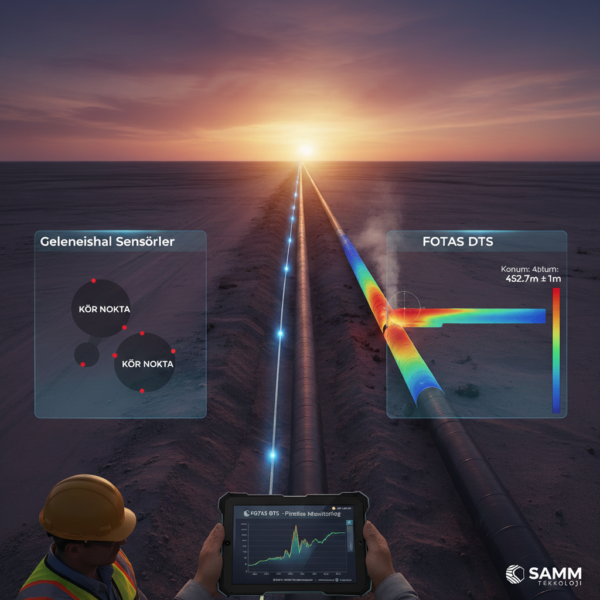
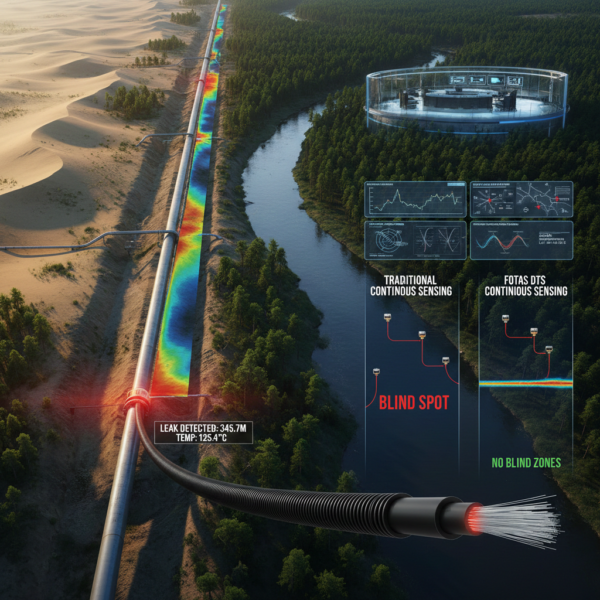
Conventional point sensors only measure the specific spot where they are installed, leaving kilometers of pipeline unmonitored. In modern infrastructure, this “blind zone” approach creates an unacceptable level of risk.
Why Conventional Sensors Are Not Enough
Conventional sensors like RTDs or thermocouples fall short in complex pipeline networks:
- Limited Coverage: They only “see” the square meter where the sensor is placed.
- Prohibitive Cost: Wiring and installation costs increase exponentially over long distances.
- High Maintenance: Each sensor requires individual calibration and fault monitoring.
- Data Gaps: They cannot provide a continuous, real-time thermal profile of the entire line.
How FOTAS DTS by SAMM Teknoloji Works
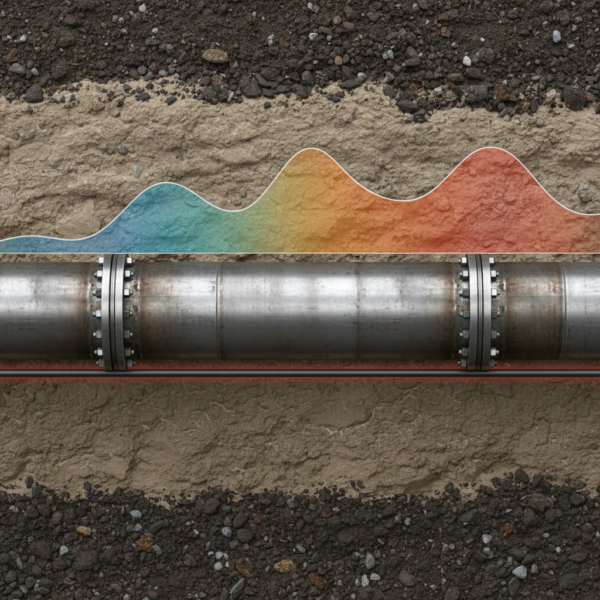
The FOTAS Distributed Temperature Sensing (DTS) system, developed by SAMM Teknoloji, transforms a standard fiber optic cable into a continuous array of thousands of temperature sensors covering the entire length of the pipeline.
Raman Scattering Based Fiber Optic Sensing
The FOTAS system analyzes the backscattering of laser signals sent through the fiber optic cable. Using the principle of Raman Scattering, every point along the fiber becomes an independent temperature measurement channel.
This provides:
- Continuous 100% coverage thermal profiling along the entire line.
- Detection of thermal anomalies at the earliest possible stage.
- Event localization with meter-level precision for rapid response.

100% Coverage vs. Point Monitoring
| Feature | Conventional Sensors | FOTAS DTS |
| Coverage Area | Point-specific only | Entire line (Seamless) |
| Location Accuracy | Low (Sensor location only) | High (Meter-level precision) |
| Maintenance | High (Thousands of sensors) | Minimum (Passive fiber line) |
| Long-Distance Cost | Very high | Economic and scalable |
Sector-Specific Use Cases
- Oil & Gas: Acts as a high-precision Leak Detection System (LDS) to catch leaks before they escalate.
- Water Transmission: Minimizes loss and theft rates to protect vital water resources.
- Geothermal Pipelines: Provides Real-Time Thermal Rating (RTTR) analysis to optimize operational performance.
Evaluate the Risk Before It Becomes a Crisis
Pipeline temperature monitoring is no longer an option—it is a fundamental requirement for modern infrastructure standards. Contact our expert team to evaluate how the FOTAS DTS system can be integrated into your existing operations.