



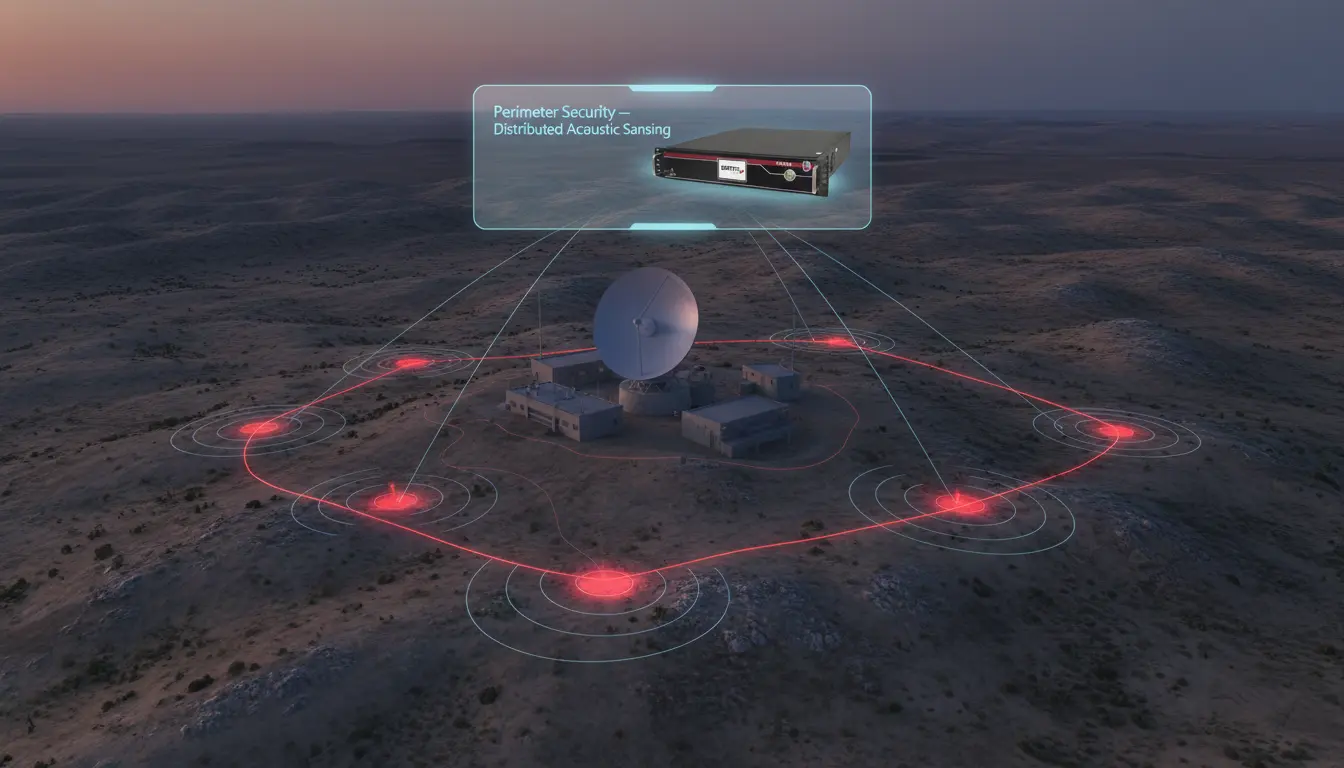
Continuous Perimeter Monitoring with Distributed Acoustic Sensing
Physical barriers have long been the default approach to site protection: fences, walls, cameras, and motion detectors. For years this was considered sufficient. Someone attempts entry, an alarm triggers, security responds. Modern facilities, however, face a different question — not whether an intrusion can be detected, but whether it can be detected before it actually happens. In large sites such as energy facilities, data centers, airports, and industrial plants, most incidents begin near the perimeter rather than inside it. The intruder is still outside, observing, digging, testing, or preparing. Conventional systems rarely recognize this stage. This is why modern security architectures increasingly rely on Distributed Acoustic Sensing (DAS) — a continuous fiber optic monitoring approach capable of detecting pre-intrusion activity along the entire perimeter rather than only after physical contact.
The Blind Spot of Traditional Perimeter Protection
Most perimeter intrusion detection systems rely on two triggers:
- Physical contact
- Visual confirmation
They detect intrusion when it occurs. Yet incidents usually begin earlier.
Typical early behaviors include:
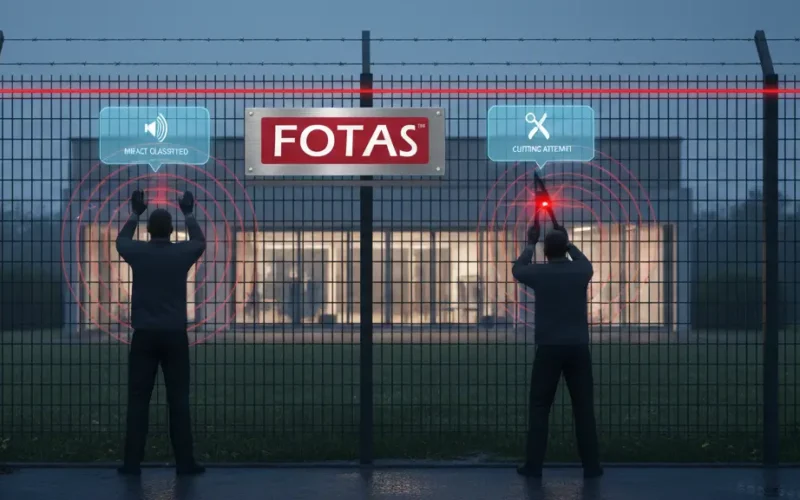
- Walking along the fence line searching for weak points
- Preparing to cut the fence
- Ground excavation
- Repeated testing near access points
These moments represent the only window where intervention can prevent escalation — but they are typically ignored.
The alarm does not come at the wrong place.
It comes at the wrong time.
The False Alarm Problem
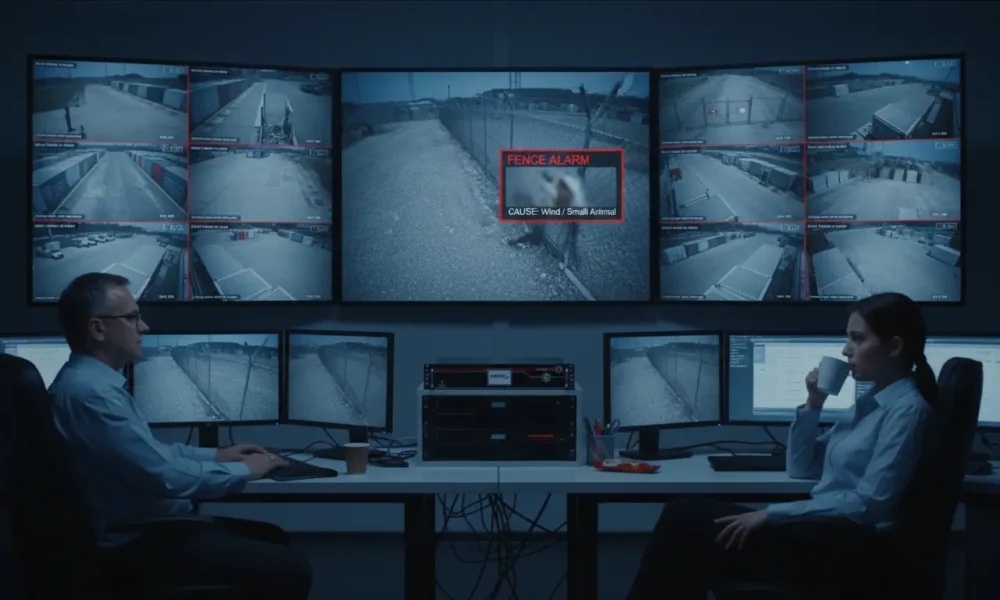
Wind, loose structures, or small animals frequently trigger conventional fence sensors. Over time, operators stop reacting with urgency. This is not just operational fatigue — it becomes a security weakness.
Security is not about detecting motion.
It is about understanding intent.
Distributed Acoustic Sensing: Turning the Perimeter into a Sensor
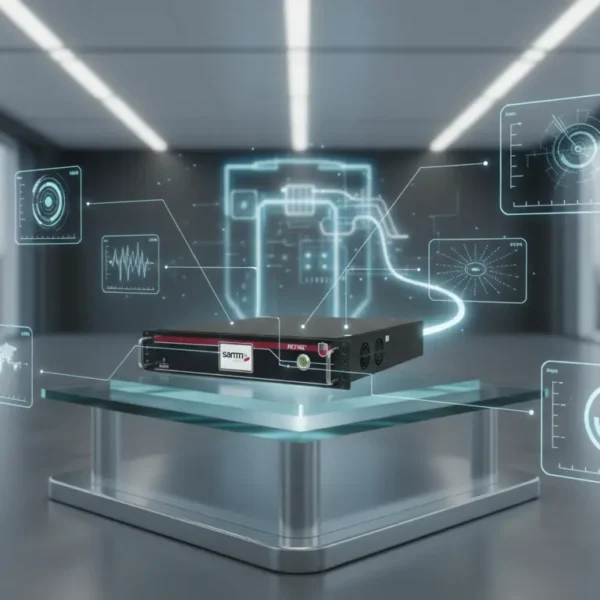
Distributed Acoustic Sensing transforms the entire perimeter into a continuous listening surface. A fiber optic cable acts as a sensor along its full length.
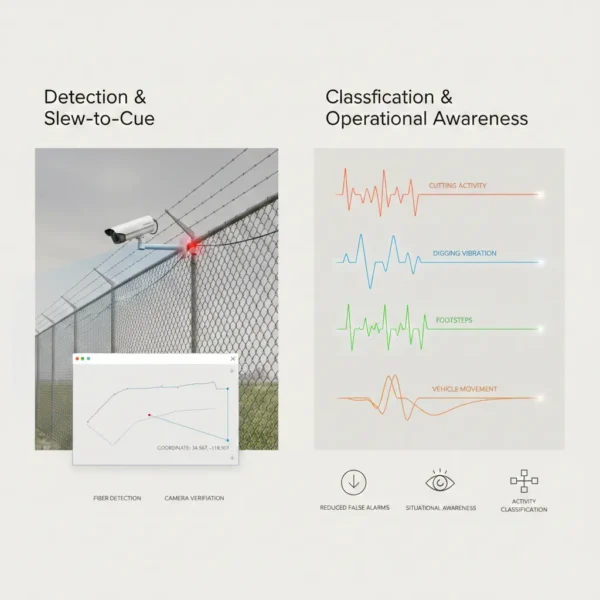
Instead of only detecting vibration, the system interprets its characteristics:
- Human footsteps differ from animal movement
- Digging differs from environmental vibration
- Vehicle approach differs from fence contact
The shift is from alarm generation to event interpretation.
Early Warning Before Physical Contact
A breach takes seconds. Preparation takes minutes.
DAS makes the preparation phase visible.
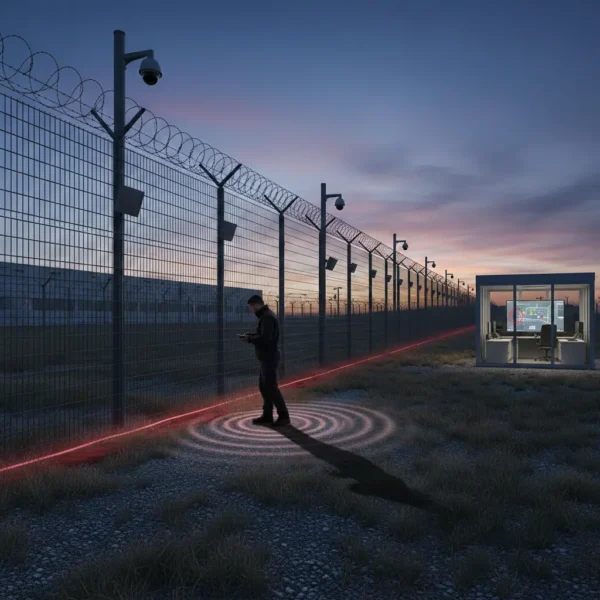
Before touching the fence, a person walks, pauses, changes direction, approaches again. These micro-vibrations propagate through the ground and structure. The system identifies the pattern and alerts operators to approaching behavior.
Security intervention becomes preventive rather than reactive.
How DAS Works with Cameras
Cameras verify. DAS directs.
When activity is detected, the system pinpoints the location with meter-level accuracy. The operator sees a precise point instead of scanning a wide area.
PTZ cameras automatically move to the coordinates and provide immediate visual confirmation. Search time disappears.
Minutes turn into seconds.
Operational Impact
Traditional systems trigger responses. DAS enables management.
Operators observe direction, speed, continuity, and type of activity. Over time, the system learns the normal acoustic profile of the site, reducing false alarms and highlighting real threats.
Security monitoring becomes situational awareness.
Continuity Instead of Sensor Quantity
Adding more sensors increases coverage but also increases maintenance risk.
In distributed fiber sensing, the field cable is passive — no power, no electronics along the perimeter. Lightning strikes or power failures do not interrupt detection.
The benefit is operational: fewer interventions, higher availability
Conclusion
Distributed Acoustic Sensing shifts perimeter protection from a passive barrier to active awareness. It identifies intent, localizes events, and interprets behavior.
In modern security environments, effectiveness is no longer defined by stronger fences, but by knowing where to look before something happens.
Forward-Looking Note
Beyond perimeter protection, the same sensing approach can be extended along buried pipelines, communication corridors, and other linear critical infrastructure.
Once the infrastructure itself becomes the sensing medium, security is no longer tied to a boundary — it becomes inherent to the asset.