Distributed Acoustic Sensing (DAS) Technology

 What is DAS?

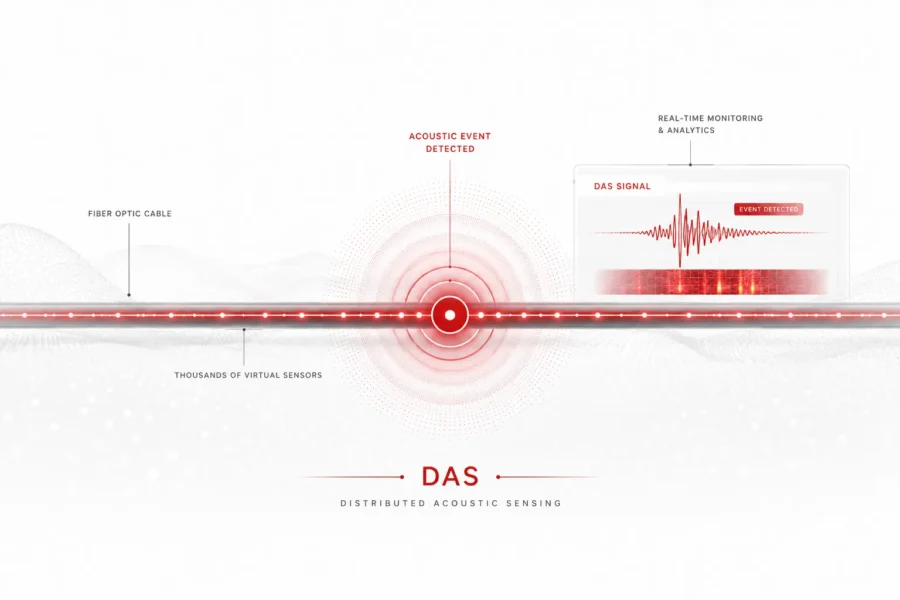
Distributed Acoustic Sensing (DAS) stands as a revolutionary technology offering real-time insights into acoustic and vibration data along the length of a fiber optic cable. Essentially, it transforms standard optical fiber or specially designed cables into a vast network of sensitive virtual microphones or vibration sensors. DAS captures an extensive array of acoustic information from these virtual microphones, all in real-time. Acoustic waves are pressure waves that occur due to force fields. The force going through materials causes pressure replacements. DAS systems are widely used in industries like energy, transportation, and security, helping to monitor long distances efficiently and reliably.
fotas das graik

Role of Fiber Optics in DAS Technology

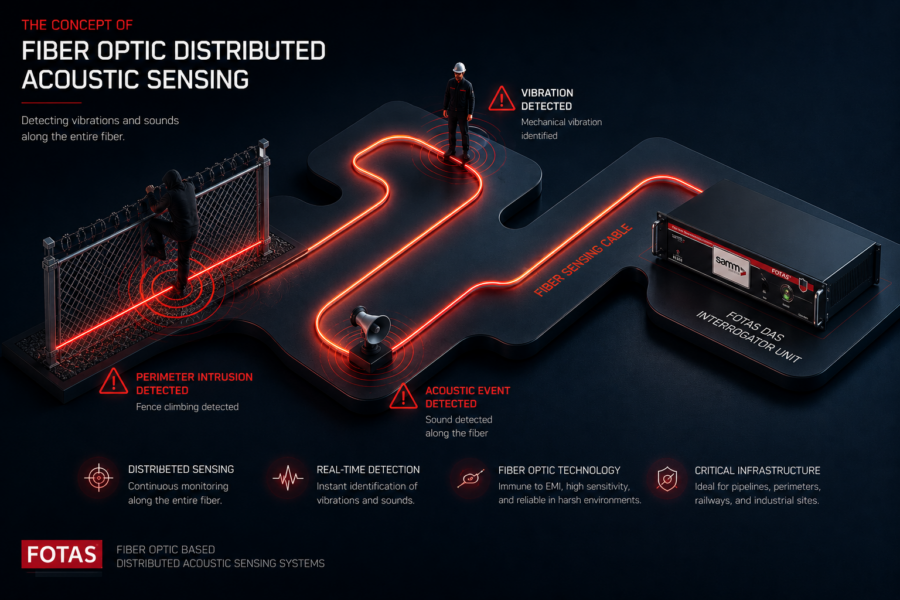
FOTAS utilizes fiber optic cables for Distributed Acoustic Sensing. Most DAS systems employ fiber optic cables. Light waves propagate into the fiber optic cable, being affected by acoustic waves. These affected light signals can be detected by devices such as Optical Time Domain Reflectometry (OTDR) units. The high sensitivity of fiber optic cables makes DAS systems indispensable in many industries. Unlike traditional sensors that measure at determined fixed points, the fiber cable itself is used as a sensor in the DAS system, effectively turning the entire fiber cable into a network of microphones. This feature allows the system to collect detailed data at every point, enabling more efficient monitoring of large areas.

das sytem

DAS Application Areas

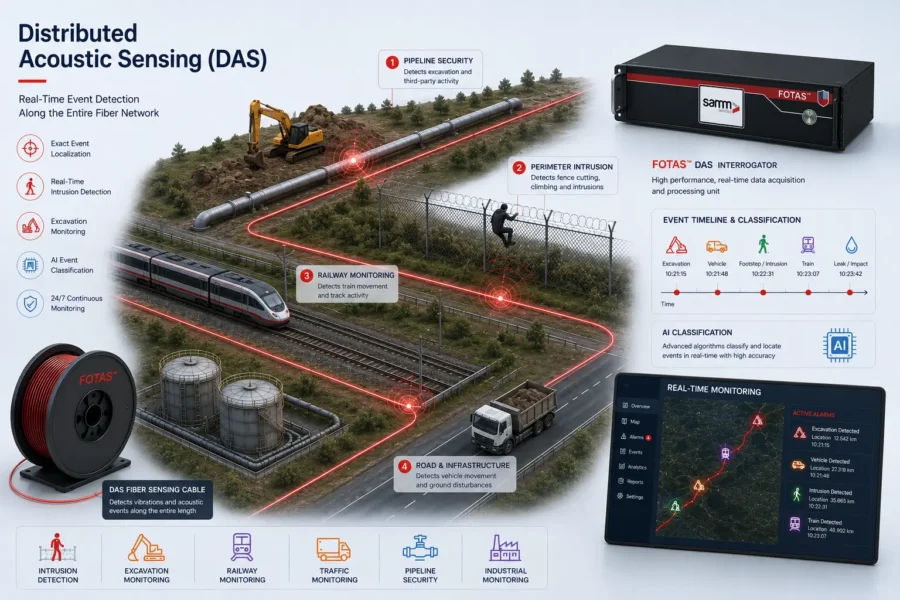
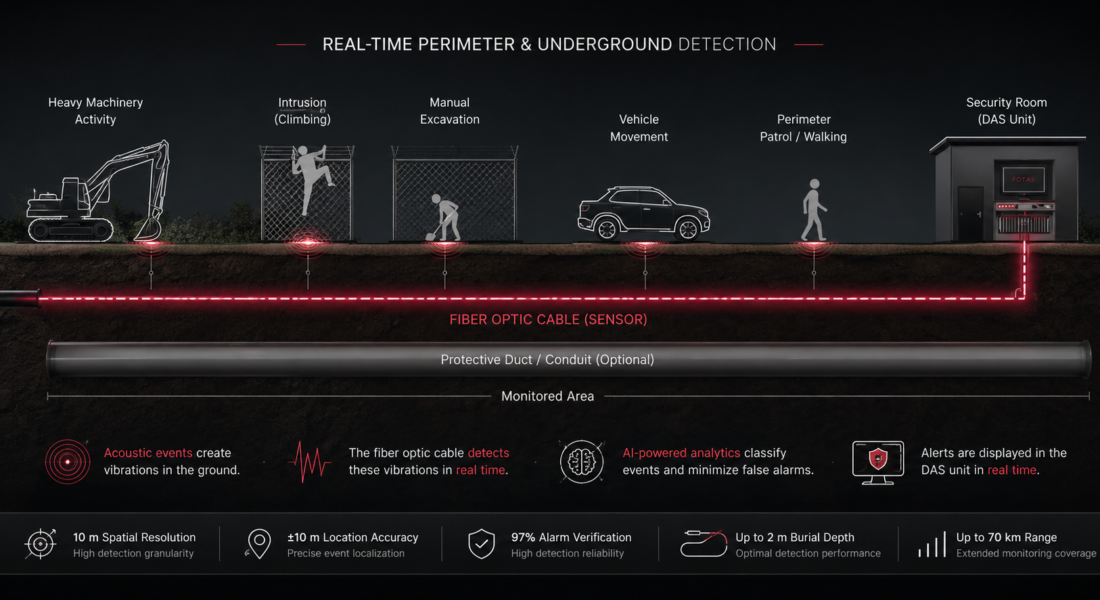
DAS finds application across various linear assets such as pipelines, roads, railway tracks, borders, and fences. Employing tailored algorithms, it enables the monitoring, tracking, and detection of diverse activities and events along these assets, including vehicle and human traffic, excavation, or tunneling. Moreover, it serves as a valuable tool for asset condition monitoring, facilitating the detection of incidents like pipeline leaks or damaged rails, among others. Fiber optic distributed acoustic sensing serves various applications including seismic sensing, border and perimeter security, pipeline integrity monitoring, and safety assurance in industrial, mining, hydropower, and transportation infrastructure. Additionally, fiber cables can detect temperature changes, although this function is distinct from acoustic sensing.

das spp

FOTAS DAS System (Specific Features of Your Product)

FOTAS (Fiber Optic Based Distributed Acoustic Sensing) systems utilize distributed acoustic sensing for security and detection purposes, leveraging existing fiber optic infrastructure. These systems excel in detecting activities such as digging, excavations, and trespassing, with real-time monitoring of vibrations like walking, precise to 10 meters. By utilizing neglected zones, false alarms in constantly active areas are minimized, with all received alarms reported via web interface and stored for analysis.

Conclusion: The Importance of DAS Technology and FOTAS

Distributed Acoustic Sensing represents a groundbreaking technology offering unparalleled insights into acoustic and vibrational data, with wide-ranging applications across various industries and sectors. DAS technology is a powerful tool for providing real-time monitoring and precise detection over large areas. The use of fiber optic cables as sensors offers both cost advantages and high efficiency. Systems like FOTAS play a crucial role in industries such as energy, security, and transportation. The flexibility provided by this technology will enable its application in even more fields in the future.

das working