


Existing Subsea Fiber as Sensors
Fiber optic cables already laid across the Marmara seabed, between Ambarlı and Pendik, are used as a continuous seismic sensing array.


A Distributed Acoustic Sensing–based early warning and monitoring system that turns existing subsea fiber optic cables in the Marmara Sea into seismic sensors — protecting critical infrastructure across Istanbul and its surroundings.
FOTDES is being developed to address the potential earthquake threat to the Marmara Sea, representing an important technology for protecting critical infrastructure in Istanbul and its surroundings. The project repurposes existing fiber optic cables on the seabed — running between Ambarlı and Pendik — as early-warning sensors.
Depending on the earthquake's epicenter, the system aims to provide an early warning window of 3 to 30 seconds — a time frame that is vital for critical infrastructure and transportation systems, with artificial intelligence and machine learning planned as part of the platform.
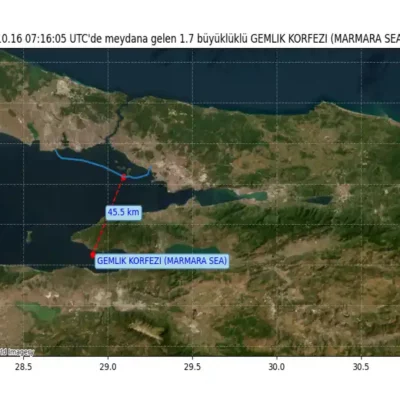
Using Distributed Acoustic Sensing over fiber optic cables extending across the seabed and land, the FOTAS S-50 detects hazardous-intensity earthquakes and the seismic waves they generate.
Fiber optic cables already laid across the Marmara seabed, between Ambarlı and Pendik, are used as a continuous seismic sensing array.
DAS technology detects the seismic waves of a significant event as they propagate, enabling detection well before shaking reaches the city.
Depending on the epicenter, the system delivers a 3–30 second warning — enough time to trigger automated protective actions.
A few seconds of warning is enough to shut down, slow or safeguard key systems — helping to prevent secondary disasters such as fires and explosions, and to protect lives and property.
Talk to our engineering team about FOTAS Distributed Acoustic Sensing for earthquake early warning, subsea and pipeline monitoring, and other critical-infrastructure applications.