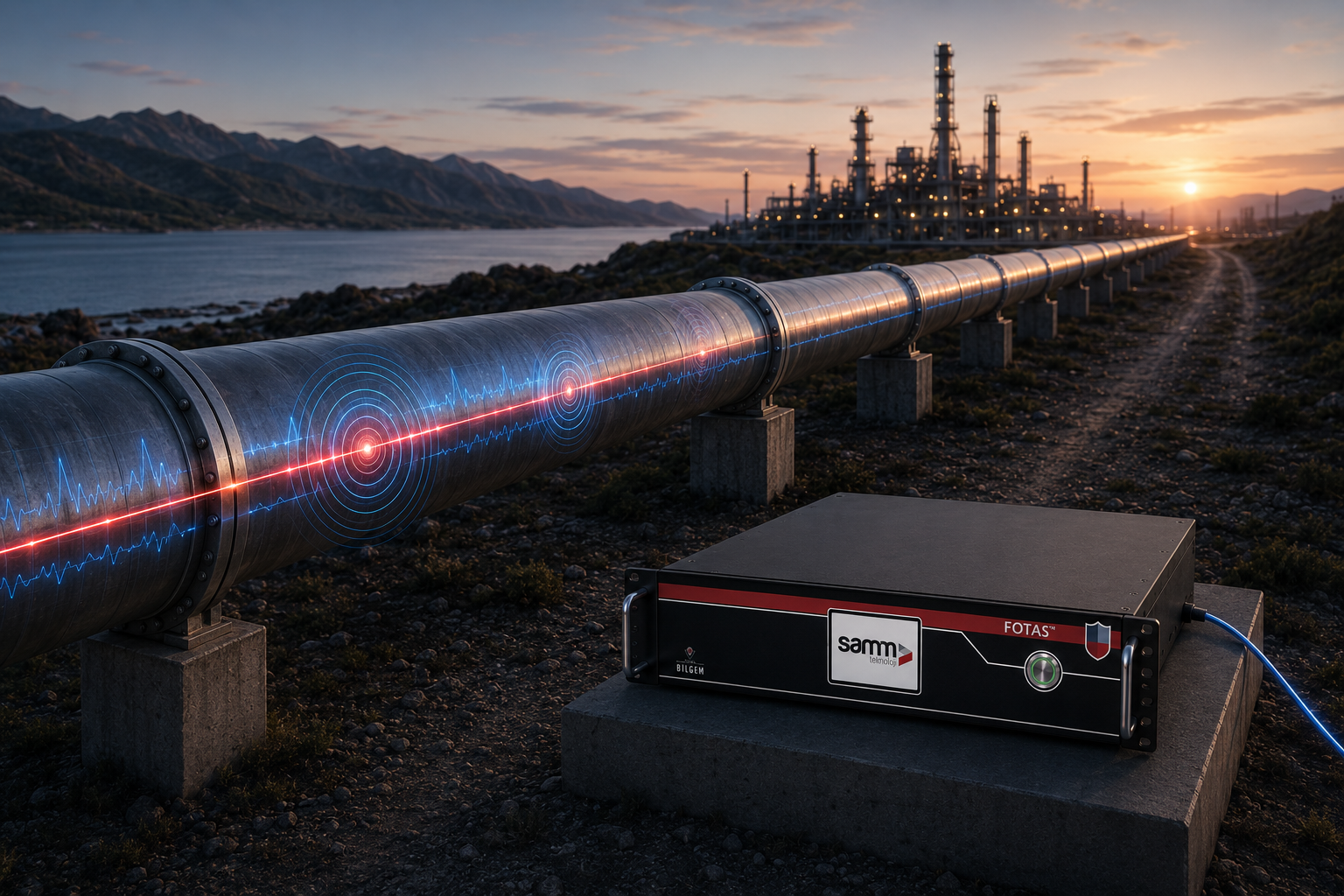
Pipeline Security with Distributed Sensing Monitoring Technology

Fiber Optic Monitoring and Protection for Oil & Gas Infrastructure

Crude oil, natural gas, and chemical transmission pipelines often extend across remote and environmentally sensitive regions where operational visibility is limited and response times are critical. Protecting these assets requires more than periodic inspection or manual patrols. Modern energy infrastructure demands continuous, real-time monitoring.

Developed by SAMM Teknoloji, the FOTAS platform combines Distributed Acoustic Sensing (DAS) and Distributed Temperature Sensing (DTS) technologies to provide continuous monitoring across pipeline corridors and critical oil & gas infrastructure. Using fiber optic sensing infrastructure, FOTAS delivers real-time operational awareness for pipelines, wellhead facilities, refineries, pumping stations, and remote field assets.
A fiber optic sensor system attached to a long oil or gas pipeline across a desert landscape.
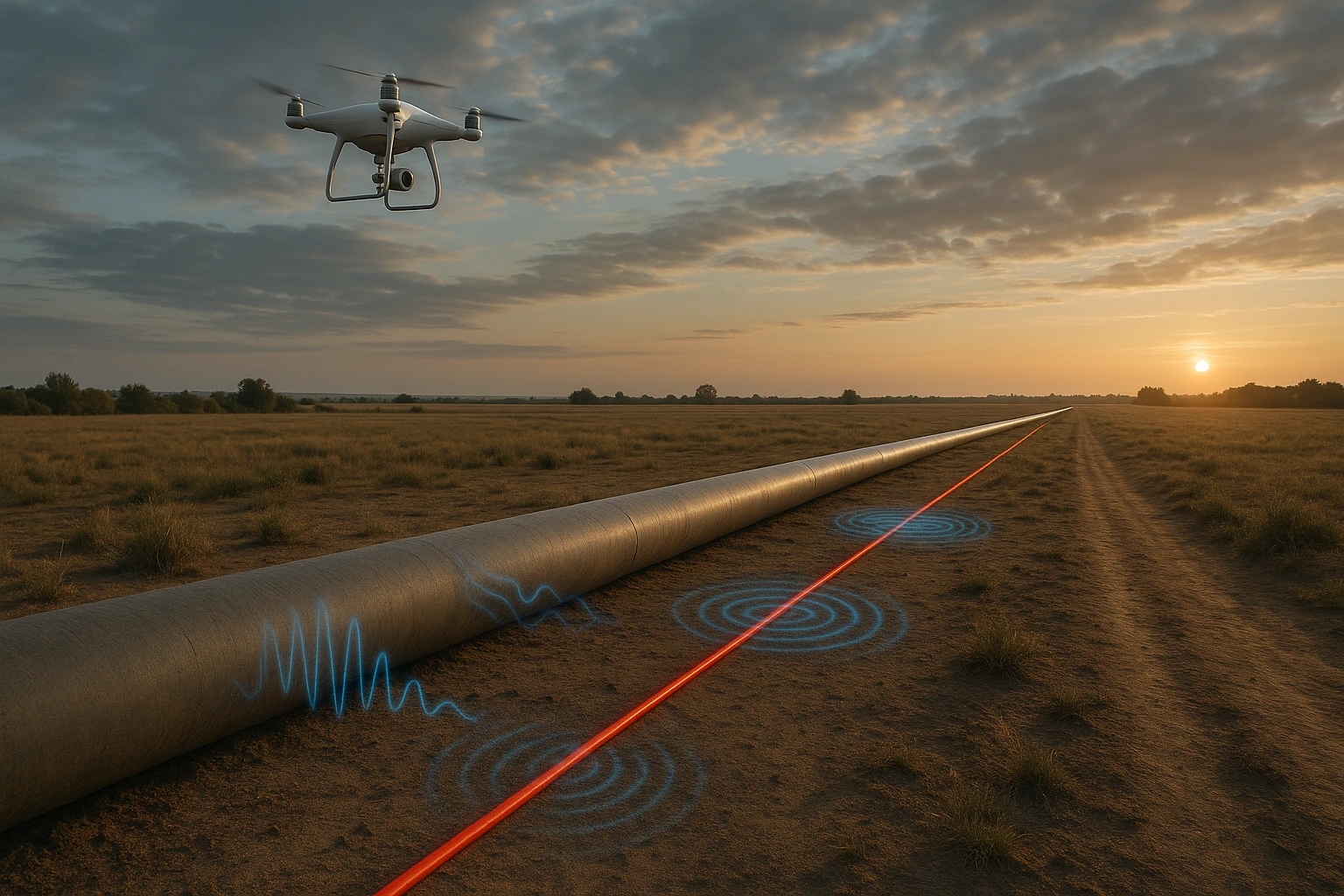
A long oil pipeline runs through an open field at sunset. A red fiber optic line runs alongside it. A drone hovers above, while seismic waves and vibration patterns are detected underground.

Monitoring Beyond Conventional Patrol Methods

Traditional monitoring methods such as manual inspection, CCTV coverage, or aerial patrols can be costly, limited in coverage, and difficult to maintain across long-distance infrastructure.

FOTAS enables continuous monitoring over extended distances through distributed fiber optic sensing technologies. The system can detect acoustic activity, mechanical vibrations, ground disturbances, and temperature anomalies associated with operational events or security risks along the pipeline route.

This approach helps operators improve situational awareness, reduce response times, and strengthen infrastructure protection in remote environments.

DAS and DTS: Two Complementary Monitoring Technologies

Distributed Acoustic Sensing (DAS)

Distributed Acoustic Sensing technology monitors vibration and acoustic activity along the fiber route in real time.

DAS can detect:

  • Digging and excavation activity near the pipeline
  • Third-party interference and unauthorized movement
  • Mechanical vibrations and ground disturbances
  • Leak-related acoustic signatures and flow anomalies
  • Vehicle movement and activity around critical infrastructure

By continuously monitoring acoustic and vibration-related events, DAS supports rapid threat detection and improves response efficiency across large-scale pipeline networks.

Distributed Temperature Sensing (DTS)

Distributed Temperature Sensing technology continuously measures temperature variations along the monitored infrastructure.

DTS supports:

  • Detection of abnormal temperature changes
  • Identification of overheating risks
  • Thermal monitoring of critical assets
  • Early indication of temperature anomalies associated with leaks or operational issues
  • Continuous temperature profiling in remote environments

This enables operators to improve preventive maintenance strategies and enhance infrastructure reliability

Application Areas

FOTAS supports monitoring and protection across a wide range of energy infrastructure environments, including:

  • Crude oil and natural gas transmission pipelines
  • Petrochemical and chemical transport lines
  • Refineries and pumping stations
  • Wellhead and production facilities
  • Remote and unmanned operational sites
  • Perimeter monitoring for critical energy infrastructure

Operational Advantages of FOTAS

  • Integrated DAS and DTS monitoring architecture
  • Real-time event detection and localization
  • Continuous monitoring across long-distance infrastructure
  • No electrical power required along the sensing path
  • Integration with existing fiber optic infrastructure
  • Suitable for harsh environmental and industrial conditions

Field-Oriented Infrastructure Monitoring

FOTAS is designed for real-world operational environments where continuous monitoring, rapid awareness, and infrastructure visibility are critical.

By combining distributed acoustic and distributed temperature sensing technologies, operators can gain actionable data from a single monitoring platform while improving operational efficiency and infrastructure security.

Whether monitoring long-distance transmission pipelines or securing critical field facilities, FOTAS provides scalable fiber optic sensing solutions for modern energy infrastructure.

Secure Critical Infrastructure with Fiber Optic Sensing

As energy infrastructure expands across larger and more complex environments, the need for continuous monitoring continues to grow.

FOTAS helps operators improve visibility across critical assets through distributed fiber optic sensing technologies designed for real-time operational awareness, event detection, and infrastructure monitoring.

Contact us for technical documentation, deployment information, or integration options.