


Laser Pulse Transmission
The monitoring unit transmits short optical pulses into the fibre optic sensing cable.

Distributed Temperature Sensing transforms a fibre optic sensing cable into a continuous linear temperature sensor, providing real-time temperature measurements and precise thermal event localisation across long distances.
EXPLORE DTS TECHNOLOGYDistributed Temperature Sensing, commonly referred to as DTS, is a fibre optic monitoring technology that measures temperature continuously along the full length of an optical sensing cable. Instead of measuring temperature only at isolated positions, the system creates a complete temperature profile across the monitored route.
A single sensing cable can provide thousands of distributed measurement points. This allows large, extended and complex assets to be monitored continuously without installing separate electronic sensors at every measurement location.
The sensing cable can be installed alongside power cables, pipelines, tunnels, conveyor systems, industrial equipment, storage facilities and other critical infrastructure where continuous thermal visibility is required.
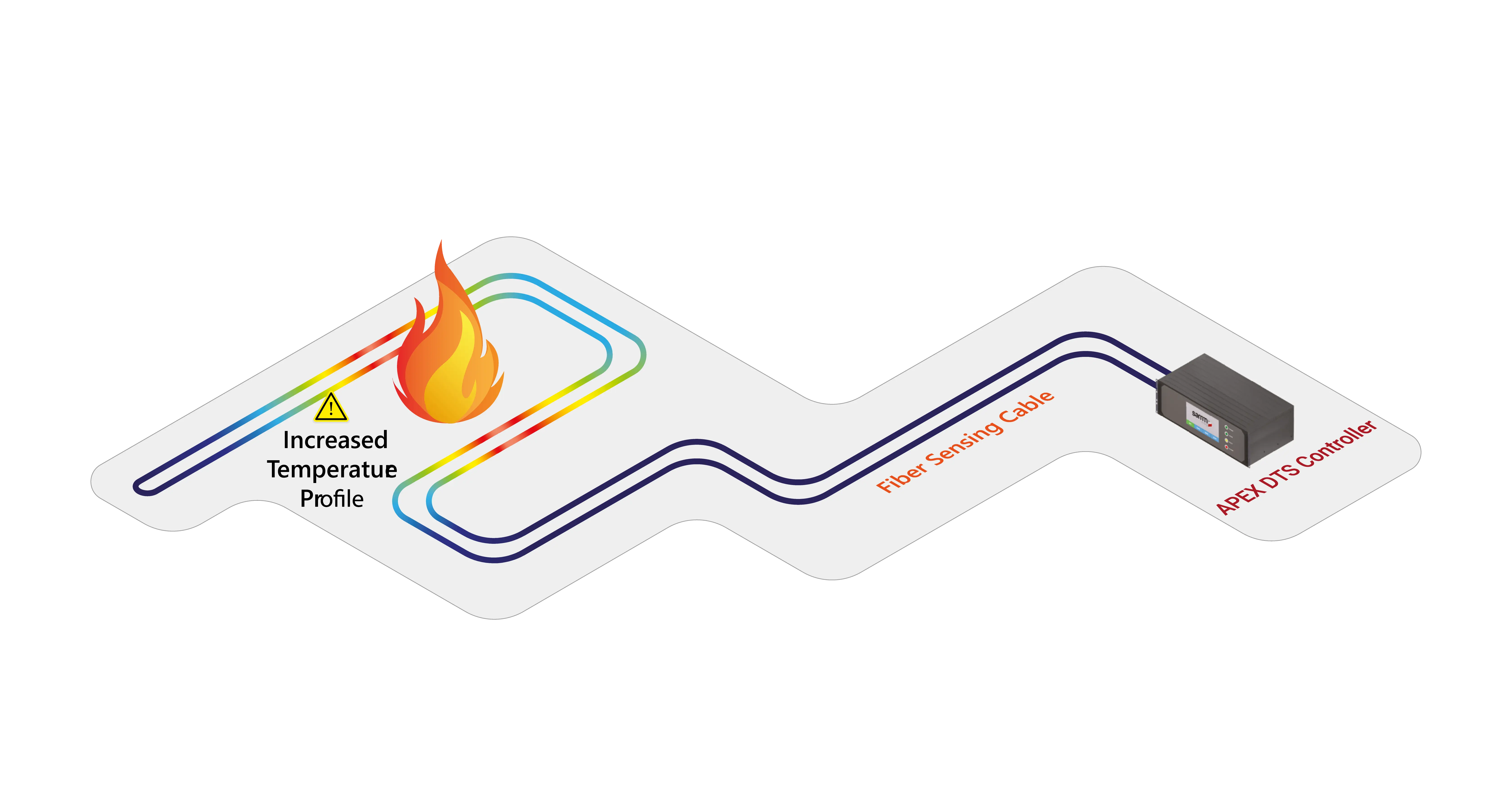
A DTS unit sends short laser pulses into the optical fibre. As each pulse travels through the fibre, a small portion of the light is scattered back towards the monitoring unit.
This returned optical signal includes Raman Stokes and Anti-Stokes components. The Anti-Stokes component is particularly sensitive to temperature, while the relationship between the Stokes and Anti-Stokes signals enables the system to calculate the temperature at different positions along the fibre.
The system also measures the return time of the scattered light. Because the speed of light through the fibre is known, this timing information allows the DTS unit to determine where each temperature measurement originated.
The result is a continuous temperature profile that shows both the measured temperature and its location along the sensing cable.

The optical fibre acts as the sensing element throughout the monitored route. Each measurement cycle produces distributed temperature data rather than a reading from only one physical sensor location.
Measurement settings such as spatial resolution, response time, sensing distance and temperature accuracy depend on the selected DTS configuration and the requirements of the application.
The monitoring unit transmits short optical pulses into the fibre optic sensing cable.
A small amount of light returns from every position along the fibre route.
The return time of the optical signal identifies the position of each measurement.
The system generates a continuous temperature profile along the sensing cable.
DTS is particularly valuable when temperature must be monitored continuously across long distances, inaccessible locations or environments where conventional point sensors would leave large gaps between measurements.
Continuous heat monitoring in tunnels, cable galleries, warehouses, car parks and other extended environments.
Identification of overheating, developing hot spots and abnormal thermal behaviour along power cable routes.
Temperature monitoring across conveyors, furnaces, reactors, storage systems and industrial production equipment.
Detection of temperature anomalies associated with leakage, process changes and abnormal pipeline conditions.
Continuous temperature coverage across road, rail, metro and utility tunnels where early warning is essential.
Historical temperature trends and localised thermal deviations can support maintenance and operational decisions.
The sensing cable contains no powered measurement electronics along the monitored route. This simplifies field deployment and makes fibre optic sensing suitable for many electrically noisy, remote or difficult environments.
Continuous distributed measurement also reduces the blind areas that may exist between conventional point sensors. Thermal events can be detected and associated with their position along the fibre route.
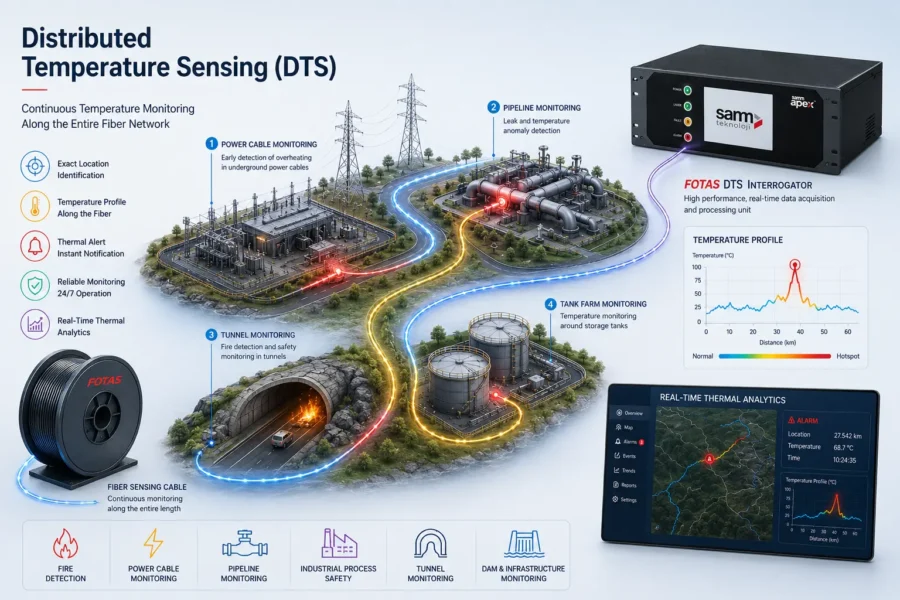
The FOTAS portfolio includes two dedicated DTS platforms. FOTAS APEX addresses linear heat and fire detection, while FOTAS INTEGRITY focuses on thermal condition and asset monitoring.
FOTAS APEX creates a continuous temperature profile along the protected route and supports fixed-temperature, rate-of-rise and localised heat alarm strategies.
FOTAS INTEGRITY provides continuous temperature profiles, historical thermal trends and localised hot-spot information for critical assets.
Contact the FOTAS engineering team to discuss sensing distance, cable selection, installation route, alarm requirements and system integration.