Fire Detection

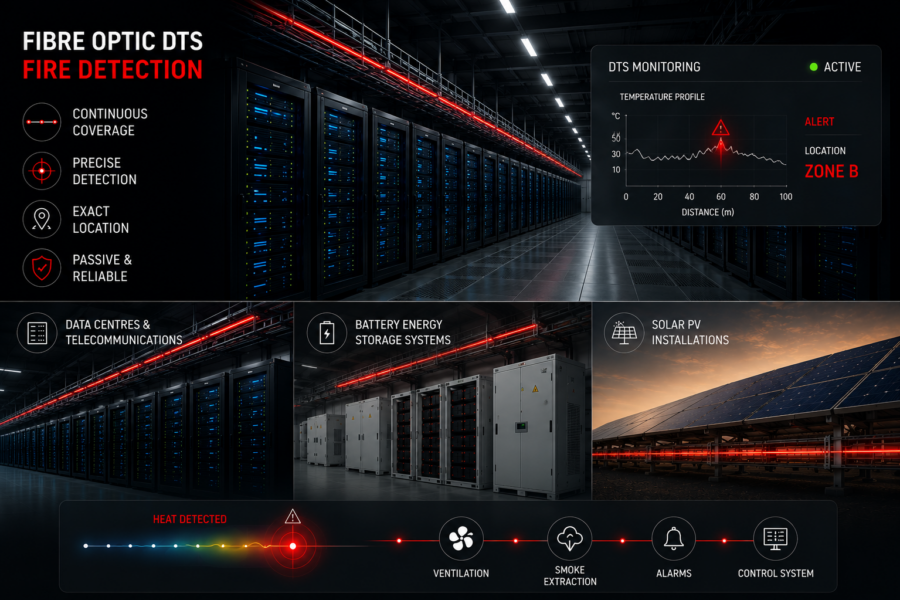
Fibre optic fire detection uses Distributed Temperature Sensing (DTS) to monitor temperature continuously along a sensing cable, helping to identify and localise thermal events associated with developing fire risks across extended or high-risk environments.

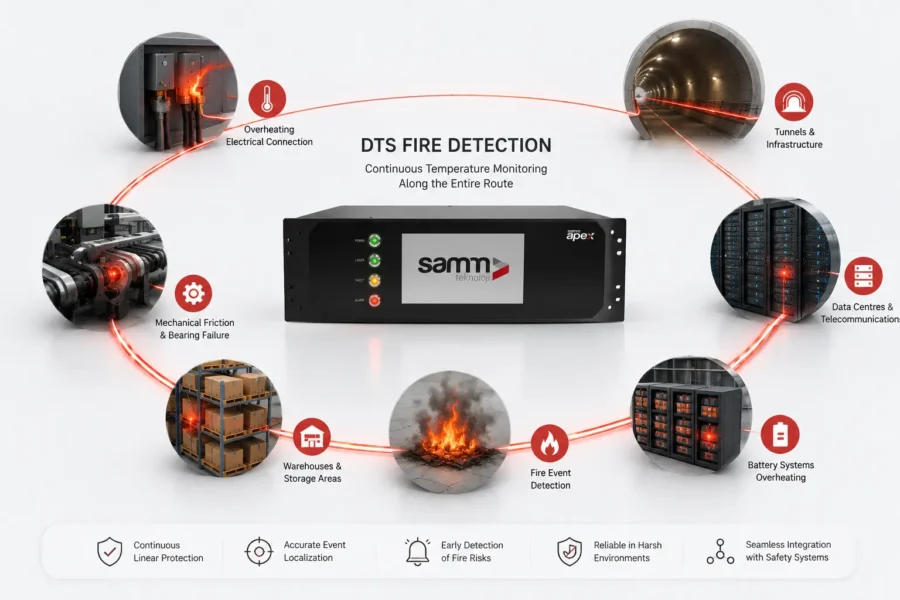
Fire risks do not always begin with visible flames or smoke. In industrial facilities and critical infrastructure, a developing incident may first appear as an overheating electrical connection, mechanical friction, a failing bearing, a localised hot spot or abnormal heating within a battery system.

DTS provides distributed temperature information along the optical fibre rather than at isolated measurement points alone. In fire detection applications, the sensing fibre acts as a continuous linear heat detector, supporting thermal event detection and localisation along the monitored route.

fibre-optic-dts-fire-detection
fotas aperx dts

Early Fire Detection with Distributed Temperature Sensing

A DTS fire detection system continuously monitors temperature along the fibre optic sensing cable. Depending on the system design, application and alarm strategy, it can identify conditions such as:

  • Temperatures exceeding defined thresholds
  • Abnormal rates of temperature rise
  • Localised hot spots
  • Developing thermal anomalies relevant to fire risk
  • Events within configurable alarm zones

These criteria can be configured by zone and combined according to the fire risk, operating conditions and required response strategy.

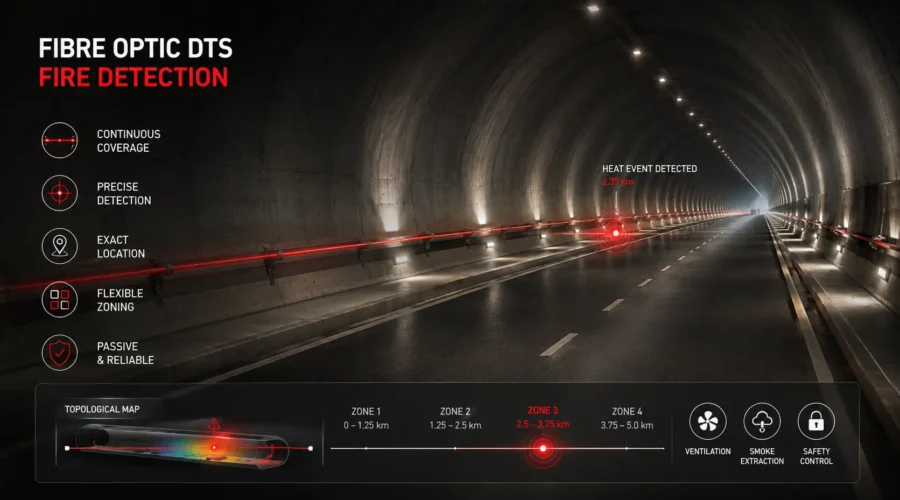
This allows operators to understand not only that an abnormal thermal event is developing, but also where it is occurring along the sensing route. In tunnels, conveyor systems, cable routes and other extended assets, event localisation can support faster investigation and a more targeted response.

The underlying optical principles of DTS, including Raman backscattering and distributed temperature measurement, are covered separately in our technology content.

Explore DTS Technology →

fiber_ optic-dts-fire-detection-system

Why Fibre Optic DTS for Fire Detection?

Different fire detection technologies serve different purposes. DTS is particularly valuable where the protected environment is long, distributed, difficult to access or exposed to demanding operating conditions.

Key advantages include:

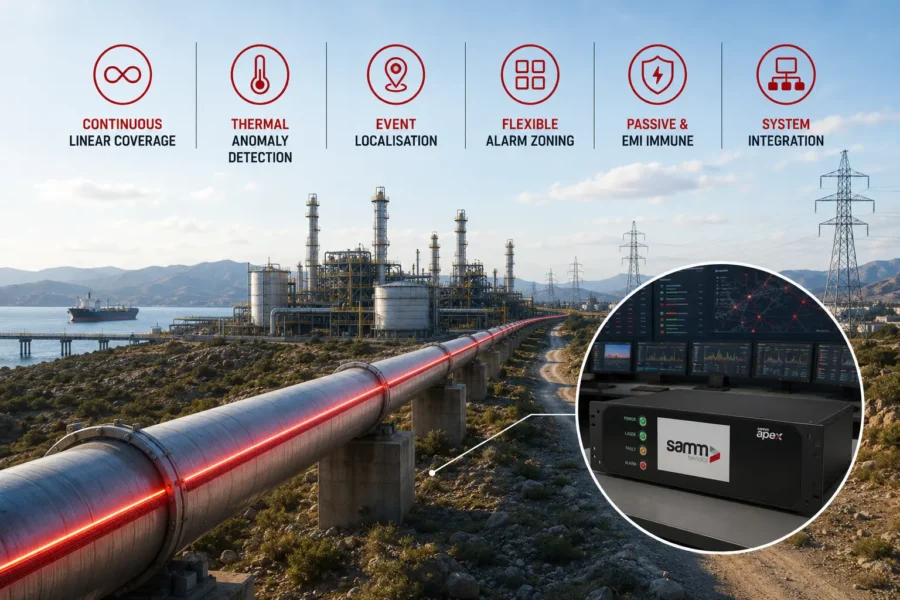
  • Continuous linear coverage along the sensing route
  • Identification of abnormal thermal conditions relevant to developing fire risk
  • Event localisation to support targeted investigation and response
  • Flexible alarm zoning for areas with different operating conditions and risk profiles
  • Passive fibre optic sensing with no electrical power required at each measurement point
  • Immunity to electromagnetic interference, particularly relevant around electrical and industrial infrastructure
  • Long-distance monitoring for extended and complex assets
  • Integration capability with wider fire, safety and control systems

Actual sensing range, response behaviour and localisation performance depend on system configuration and application conditions. DTS fire detection should therefore be engineered around the specific hazard, installation and required response strategy.

fibre-optic-dts-fire-detection-tunnel-monitoring

Fire Detection Across High-Risk Sectors

The sensing principle remains consistent, but fire risks differ significantly between sectors. A tunnel, conveyor system, data centre and battery installation should not be treated as variations of the same fire scenario. Each requires an application-specific approach to sensing cable placement, alarm logic, zoning and system integration.

Transportation

Road, rail and metro tunnels require continuous fire detection across long, enclosed routes. DTS supports linear heat detection, event localisation and integration with emergency systems.

Explore the Application Note: DTS for Road, Rail and Metro Tunnels →

Mining and Industrial

Conveyors and industrial facilities face fire risks from friction, overheated components and combustible materials. DTS provides continuous thermal monitoring across high-risk areas.

Explore the Application Note: DTS for Conveyor Belts →

Explore the Application Note: DTS for Warehousing, Storage and Logistics →

Data Centres and Telecommunications

High power densities, extensive cable routes, UPS equipment and batteries create multiple thermal risk zones. DTS supports continuous monitoring across critical infrastructure.

Explore the Application Note: DTS for Data Centres and Telecommunications Infrastructure →

Energy and Utilities

Transformers, substations, BESS and solar PV installations face risks from electrical faults, overheating and abnormal battery heating. DTS supports detection and localisation of thermal anomalies.

Explore the Application Note: DTS for Transformers, Substations and Battery Energy Storage Systems →

Explore the Application Note: DTS for Solar PV Installations →

fibre-optic-dts-fire-detection-data-centre-energy

Fire Detection Technology Comparison

Technology Detection Approach Typical Strength
Fibre Optic DTS Continuous distributed temperature measurement Extended, complex or demanding environments requiring linear thermal coverage and event localisation
Point Heat Detectors Heat detection at fixed positions Defined local areas with established detector layouts
Smoke Detectors Detection of smoke or combustion products Many occupied and enclosed environments
Traditional Linear Heat Detection Cable Heat response along a cable route Route-based fire detection
Flame Detectors Detection of optical flame signatures Rapid flame detection within suitable fields of view

Integration and System Design

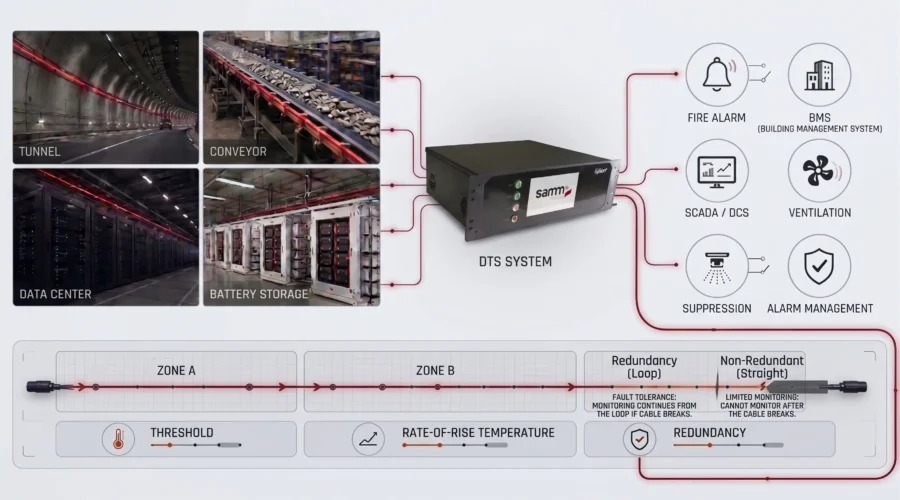
An effective DTS fire detection system depends on more than the controller alone. The complete sensing architecture should reflect the physical environment, credible fire scenarios and required response strategy.

Important design considerations include:

  • Sensing cable placement and thermal exposure
  • Cable selection for environmental and mechanical conditions
  • Alarm thresholds and rate-of-rise logic
  • Zoning for different operating conditions and risk areas
  • Redundancy requirements for critical infrastructure
  • Integration with existing safety and operational systems

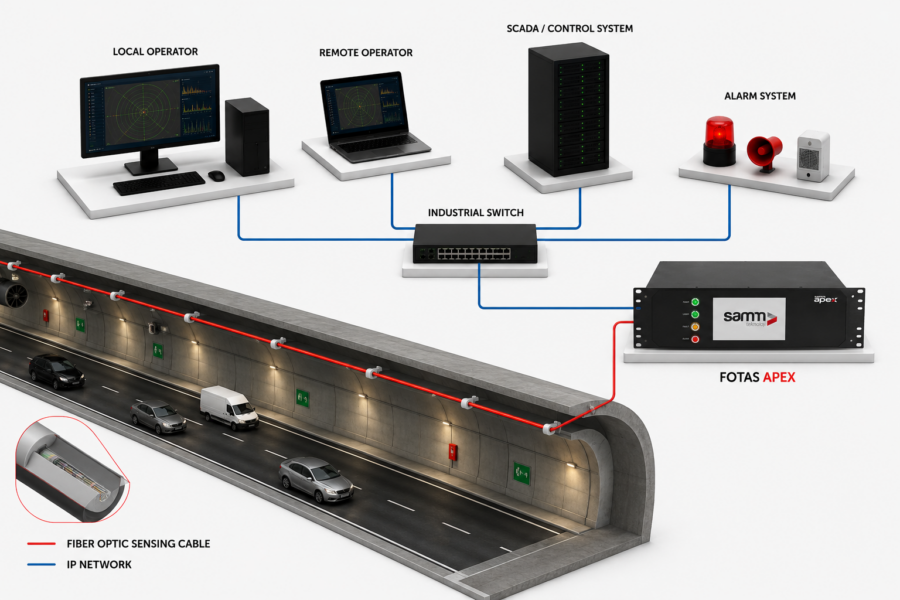
Depending on the project architecture, DTS can interface with systems such as fire alarm platforms, BMS, SCADA, DCS, ventilation, smoke extraction, suppression systems and alarm management platforms. Detected events can support operator notification, event visualisation and predefined response workflows.

The appropriate design differs between a tunnel, conveyor, data centre and battery installation. Application-specific engineering is therefore essential.

fibre-optic-dts-fire-detection-system-integration

FOTAS APEX for Fibre Optic Fire Detection

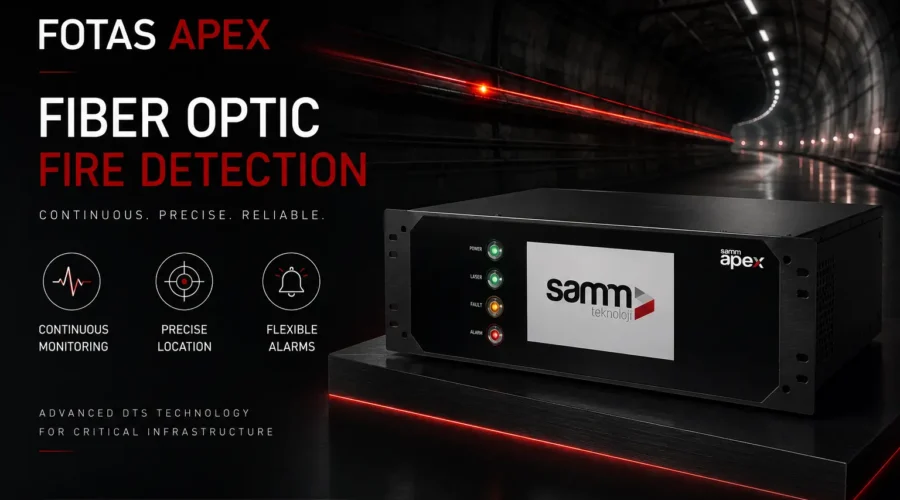
FOTAS APEX is a DTS-based solution developed for fibre optic linear heat detection and fire detection applications. It provides continuous temperature monitoring along the sensing route, supporting configurable alarm strategies and localisation of abnormal thermal events relevant to fire risk.

APEX is intended for demanding infrastructure and industrial environments where continuous thermal coverage provides greater operational value than isolated temperature measurements alone. Applications include tunnels, conveyor systems, data centres, electrical infrastructure, battery installations, warehouses and other high-risk environments.

Within the FOTAS DTS portfolio, APEX is focused on fire detection and linear heat detection, while FOTAS INTEGRITY addresses continuous condition monitoring and asset integrity.

Explore FOTAS APEX Linear Heat Detection →

Discuss Your Fire Detection Application with Our Engineering Team →

fotas-apex-fiber_ optic-fire-detection